

Legal-drama fans can finally hit play. The Lincoln Lawyer Season 4 is now streaming on Netflix, marking a pivotal moment for one of the platform’s most reliable legal thrillers. After three seasons built on sharp courtroom maneuvering and moral ambiguity, the series returns with a chapter that feels tighter, heavier, and more inward-looking. With all episodes available from day one, Season 4 invites viewers to experience the story as a single, escalating pressure chamber rather than a case-of-the-week procedural. The trailer is at the end of the article.
The Lincoln Lawyer Season 4: All the key details
- Original title: The Lincoln Lawyer – Season 4
- Genre: Legal drama / legal thriller
- Country of production: United States
- Year of release: 2026
- Director / Creator / Showrunner: Co-showrunners Ted Humphrey and Dailyn Rodriguez; Created for television by David E. Kelley
- Main cast: Manuel Garcia-Rulfo, Neve Campbell, Becki Newton, Jazz Raycole, Angus Sampson
- Based on: The Law of Innocence by Michael Connelly
- Produced by: Netflix
- Release date on Netflix: February 5, 2026
Premiere date and streaming status
The Lincoln Lawyer Season 4 premiered on Netflix on February 5, 2026, arriving as a full-season release with all episodes available from day one. The decision to drop the season in its entirety suits the show’s evolving structure, where tension is designed to accumulate rather than reset. Instead of episodic pauses, the story unfolds as a continuous escalation, allowing legal pressure and emotional fallout to build scene by scene. For viewers, it plays less like a weekly courtroom drama and more like a sustained legal siege that rewards uninterrupted viewing.


What The Lincoln Lawyer Season 4 is about
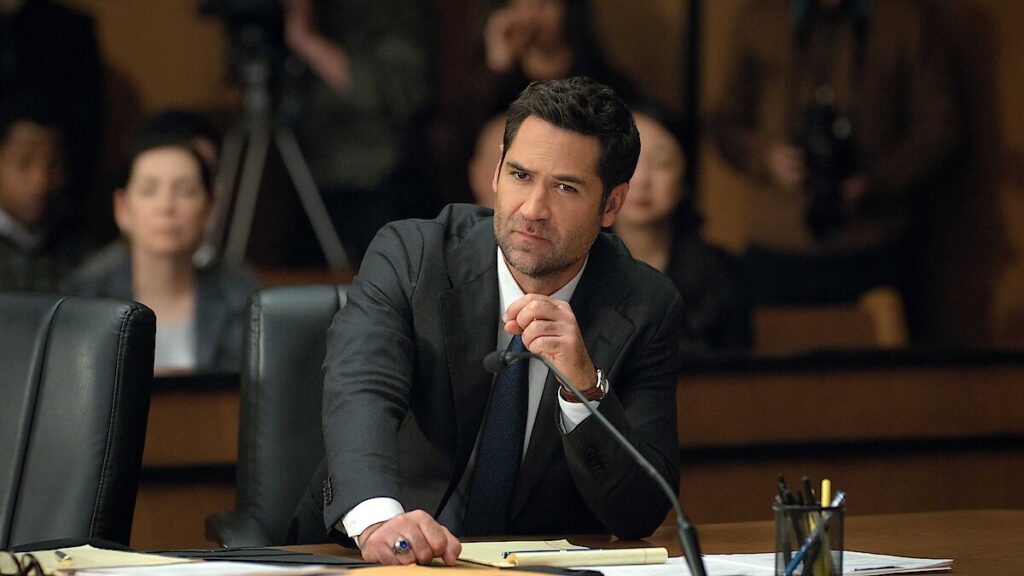
Season 4 upends the series’ foundation in the most destabilizing way possible. Mickey Haller is no longer the defense attorney controlling the tempo of the courtroom — he is the one standing accused. Forced to experience the justice system from the inside, Mickey must confront the same pressures, blind spots, and power dynamics he has spent his career navigating on behalf of others. Netflix’s official synopsis captures the pivot succinctly, framing the season as Mickey Haller’s toughest case yet — not because of its complexity, but because the outcome determines his own future.
The tension this creates is not just dramatic but structural. When Mickey becomes the client, every conversation carries risk, every alliance feels provisional, and every decision echoes beyond the courtroom. As showrunners Ted Humphrey and Dailyn Rodriguez have emphasized, the stakes are fundamentally different this time — higher not because the case is bigger, but because Mickey has nowhere to stand outside it. The series transforms from a story about legal strategy into one about survival inside the system he knows too well.
Plot overview
Season 4 adapts Michael Connelly’s novel The Law of Innocence, steering The Lincoln Lawyer into its most intimate and psychologically charged territory so far. Earlier seasons often balanced multiple cases and parallel professional challenges, but this chapter deliberately narrows its focus. The narrative locks onto Mickey Haller and applies sustained pressure, testing not just his legal instincts but his endurance, judgment, and trust in the people around him.
That compression shapes the season’s rhythm. Episodes no longer function as discrete units but as interlocking movements in a single legal battle. Courtroom maneuvers collide with private relationships, and public perception becomes as dangerous as the prosecution itself. The legal system remains the engine of the story, but the emotional cost of operating within it becomes increasingly unavoidable, turning each victory into something that feels earned — and fragile.
Cast and characters
The returning ensemble provides a strong emotional backbone as the series shifts into darker terrain. Manuel Garcia-Rulfo continues to anchor the story as Mickey Haller, supported by Becki Newton’s Lorna Crane, Jazz Raycole’s Izzy Letts, and Angus Sampson’s Cisco — characters whose loyalty and limits are tested as the pressure mounts. Neve Campbell’s return as Maggie McPherson across the season reactivates one of the show’s most layered relationships, adding personal history and unresolved tension to an already volatile situation.
Season 4 also expands its world with new characters who recalibrate the balance of power around Mickey. These additions intensify the sense of scrutiny surrounding him, reinforcing the feeling that every move is being tracked, challenged, and potentially weaponized. The result is a cast dynamic that feels sharper and more confrontational, amplifying the season’s underlying sense of risk.

Tone and creative direction
More than any previous installment, Season 4 is shaped by consequence. The series maintains its crisp dialogue and procedural clarity, but the pacing tightens and the atmosphere darkens. Scenes are allowed to breathe, silences carry narrative weight, and outcomes feel permanent rather than provisional. There is less emphasis on clever reversals and more on the emotional toll of each decision.
This creative shift places The Lincoln Lawyer closer to prestige legal thrillers that privilege character fallout over courtroom spectacle. Season 4 is not designed for casual sampling. It asks to be watched with attention, absorbed in full, and considered in hindsight — a deliberate evolution for a series willing to put its central character under the heaviest pressure yet..
Why Season 4 matters
With Season 4, The Lincoln Lawyer confirms its place as one of Netflix’s most consistent legal dramas. Rather than escalating through spectacle, the series sharpens its focus, trusting character and consequence to carry the story forward. For viewers drawn to legal thrillers that value tension over excess, this new chapter delivers a concentrated, emotionally driven continuation.
Official trailer
Here is the official trailer offering a first look at the tone, pressure, and returning characters of The Lincoln Lawyer Season 4.
